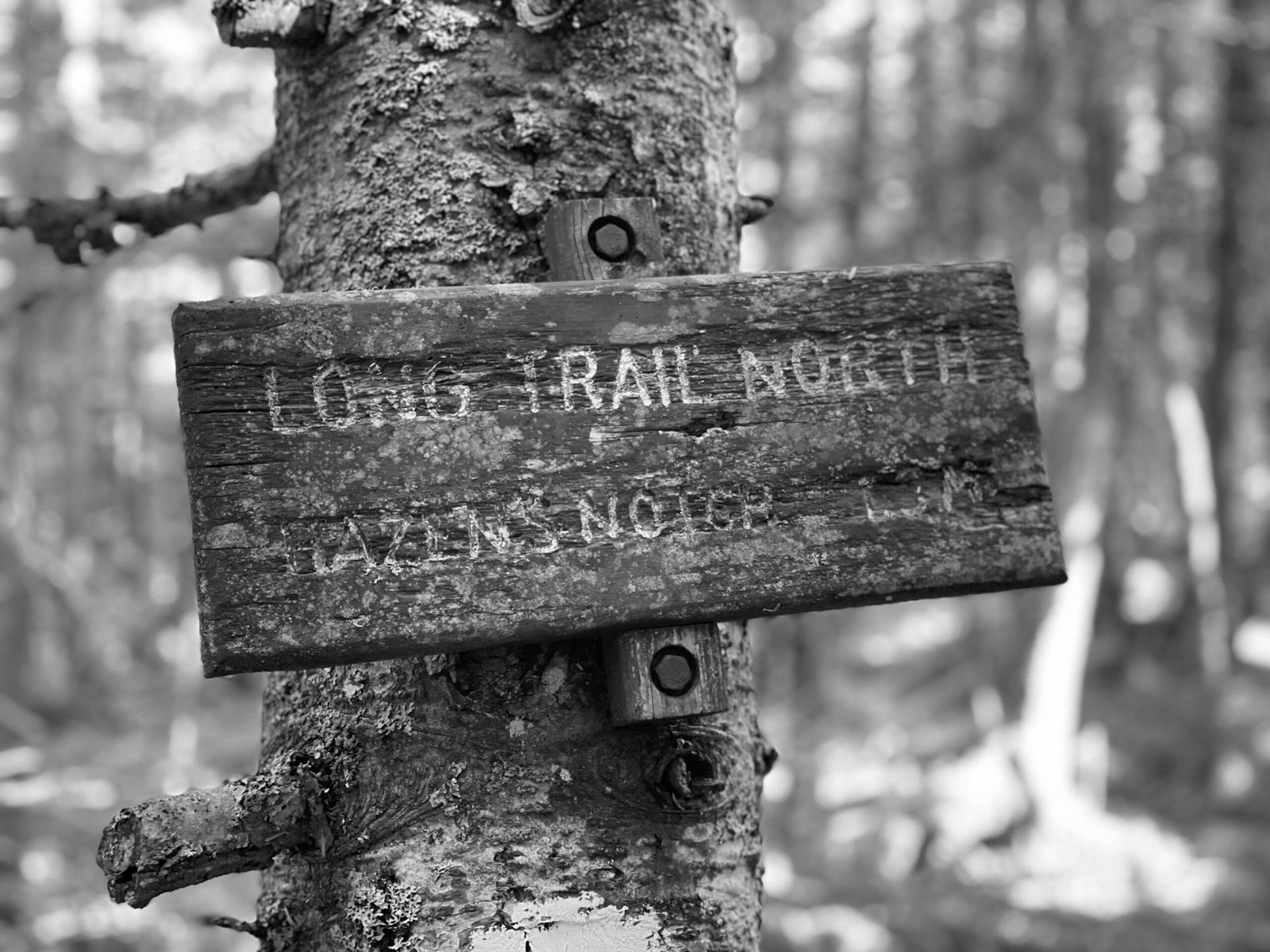
Squeezing In–
A light rain began to fall as I poked my head in the shelter, surprised to find it empty. I faced a decision: stay put or try to outrun the incoming storm to reach the next shelter. A sudden cloudburst made the choice for me. I unpacked while rain drummed rhythmically on the roof. My solitude was short-lived as the shelter soon filled with hikers shaking off the rain.
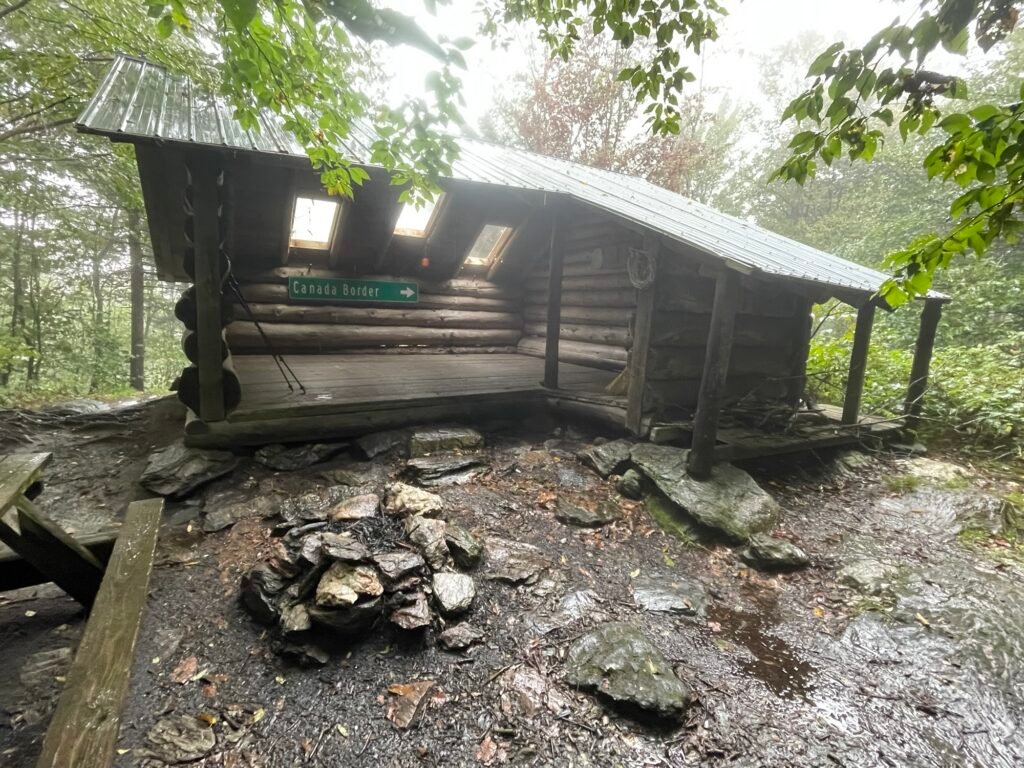
The chaos in the crowded shelter began to subside when, just before dark, a soggy hiker splashed into camp and somehow managed to squeeze in with the rest of us. As he dried off and tended his raw, blistered feet, he recounted his long day. Everyone in the shelter seemed spellbound.
“Wait, you started where this morning?” someone asked.
He had covered twice as many miles as anyone else, through very challenging conditions. His drowned appearance and the gory look of his feet validated his story.
“Why so fast?” I asked.
He wasn’t racing; he had limited vacation time and was attempting to cover the entire Long Trail in 12 days! At that time, the record for fastest known time (FKT) on the Long Trail was five days, but attempting a twelve-day hike was still impressive.
As I write this, it’s likely that at least one ultra runner is on the Appalachian Trail trying to break a speed record. In recent years, attempts to break FKT records on the AT and other trails have become quite frequent. Although many hikers shake their heads at the idea of racing on the trail, others hold these endurance athletes up as heroes. Falling somewhere in between those two points of view, I find the debate and its history quite interesting.
Race or Saunter?
Competition and fast travel seem at odds with the philosophies espoused by Muir, Thoreau, and countless hikers who spend time on the trails to relax and enjoy immersion in nature. That describes my preferred hiking style. I enjoy a pace that lets me experience the wonders of nature, explore with my camera, or just absorb the energy of special places. Racing isn’t conducive to those rewards.
But I also enjoy trail running. I find it’s great balance training for long-distance backpacking. At my advanced age, I have no illusions of running a fast time or setting records in the short trail races I enter every year. My goals are simple: have fun, stay on my feet, and don’t come in last. I typically meet those goals and sometimes place in my age group. That experience deepens my appreciation for the FKT endurance athletes as they push their bodies to the limit in pursuit of a record.
There are various categories and rules for FKT, including: unsupported, self-supported, and supported. Supported FKT attempts with pacers and support teams that provide food, shelter, and medical aid have more in common with ultra running than backpacking. Yet some in the thru-hiking community follow them closely, sharing regular online updates that include current GPS position, progression notes, comparative stats, trends, and the probability of success. To the casual observer, the stats can seem like fantasy football rubrics or horse racing sheets, handicapping the odds of success. But raw numbers tell only part of the story, and many observers find narrative updates far more compelling: the motivation, the challenges, the self-doubts, and the triumphs.
Other categories of FKT don’t receive as much fanfare. But they are no less impressive to me, especially the self-supported records on long trails like the AT. But all categories are subject to an underlying debate over the merits of racing on trails originally built for hiking.
It would be easy to view the conflicting opinions as emblematic of a culture that thrives on social media debate. But the roots of controversy existed long before the advent of the internet and social media.
A Century of Debate
The debate over speed records likely began with the first thru-hike of Vermont’s Long Trail, America’s oldest long-distance hiking trail. Soon after the trail was extended to North Jay in July of 1926, Irving Appleby traversed it southbound in 14 days, 7 hours, in what today would be called a self-supported FKT. Appleby, a former Canadian Army marathon champion, initially had the blessing of the Green Mountain Club (GMC) and was celebrated for his Long Trail record in newspaper stories across the country. But that soon changed.
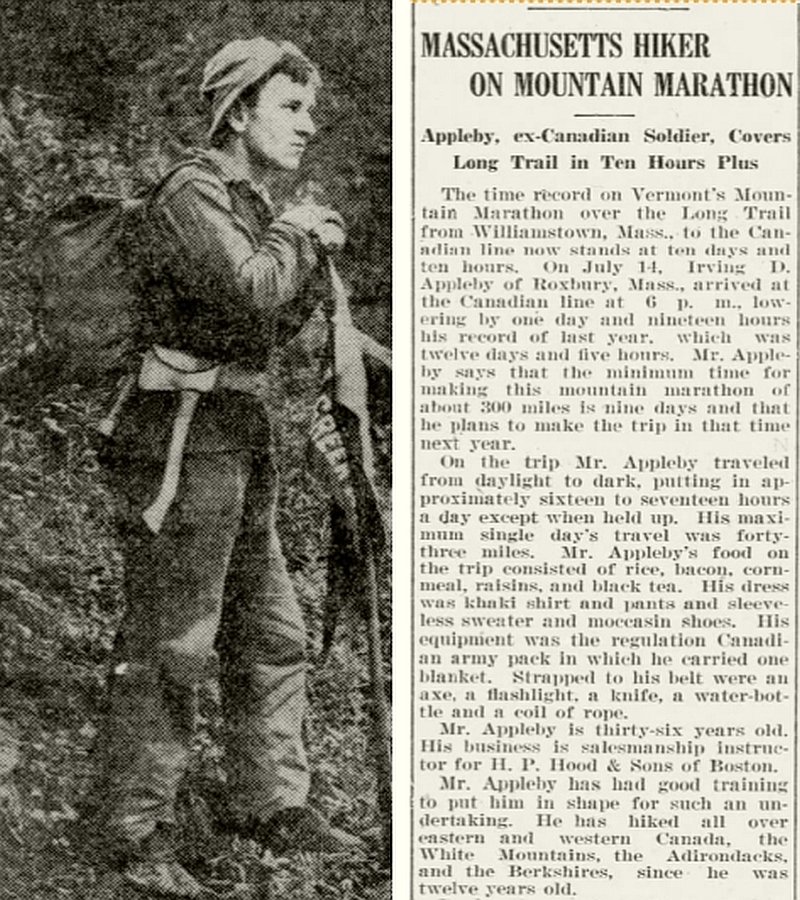
Debate over his record stemmed from inconsistencies in his accounts, combined with what many viewed as shameless self-promotion. Although the reported time was 14 days, 7 hours, he claimed it should be reduced to 12 days because he lost time escorting an ill companion off the trail, attending a dinner held in his honor, and visiting the Bennington Banner newsroom to publicize his hike. He subtracted the time from those side excursions, yet added the extra miles to his total.
The Green Mountain Club and local news outlets began to have second thoughts and scrutinized his achievement. Perhaps intoxicated by his moment in the national spotlight, Appleby objected to providing documentation of his time and distance. It turned into a war of words between Appleby, the GMC, and local newspapers.
On August 30, 1926, the Bennington Banner wrote: “There is no doubt that Mr. Appleby accomplished a remarkable feat in covering the entire distance of the Trail in so short a time, and no one wishes to detract from his glory. Nevertheless, the Long Trail is not intended to be a marathon track. It is a beautiful pathway through the heart of the Green Mountains and should be enjoyed leisurely.”
With an inflated ego that would rival some of today’s influencers, Appleby portrayed the trail as far more dangerous than it was. He described navigating a maze of ten thousand fallen trees, being forced to fell trees with an ax to cross rain-swollen torrents, enduring rapacious clouds of black flies “at the height of their pestiferousness,” and a trail that required feats of great strength and endurance that only an accomplished woodsman and marathoner could overcome. Editorials labeled some of his comments “ridiculous” and “silly.”
The Rutland Daily Herald summed it up: “In short, the Long Trail was painted as a torturous and unmarked trail through the wilds, with death in many forms stalking those who challenged it.” That wasn’t the type of publicity the GMC wanted for the Long Trail.
A New Record
Appleby returned to the trail in 1927 to improve his time and silence his detractors. His second hike was again widely publicized. This time, he claimed to have covered 300 miles in 10 days and 10 hours. The actual time was 12 days, 13 hours, and the distance covered was less than 260 miles. Yet somehow, the trail kept getting longer in newspaper stories. Appleby subtracted time for weather delays and, escorting another distressed companion, this time a champion racewalker, off the trail just two days into the NOBO attempt. The Long Trail News (LTN) poked fun at the idea of a heel-and-toe walker attempting the rugged Long Trail.
The controversy continued to spiral downward, often pitting embellishment and hyperbole against thinly veiled sarcasm in dueling letters and editorials. Newspaper reports were filled with inconsistencies in both his biography and details of the hikes. Appleby’s continued bold statements often led to scrutiny and disbelief. For example, he claimed to have witnessed a wildcat behead a rabbit on the trail in 1926, and again in 1927. That raised a few eyebrows.
In response to criticism, he boasted that his hiking kit, on display in a Boston storefront window, would likely attract over a million visitors. In response, the LTN commented: “What more could a lover of fame ask for?”
New Thru-Hiking Heroes
Within weeks of the new record, three young women, Hilda Kurth, Kathleen Norris, and Catherine Robbins thru-hiked the LT, stealing the spotlight from Appleby. The press enthusiastically followed their progress, dubbing them “The Three Musketeers.” Often pausing for interviews and photographs at trail crossings, their month-long journey provided the type of publicity that the GMC and Vermont Chamber of Commerce preferred.
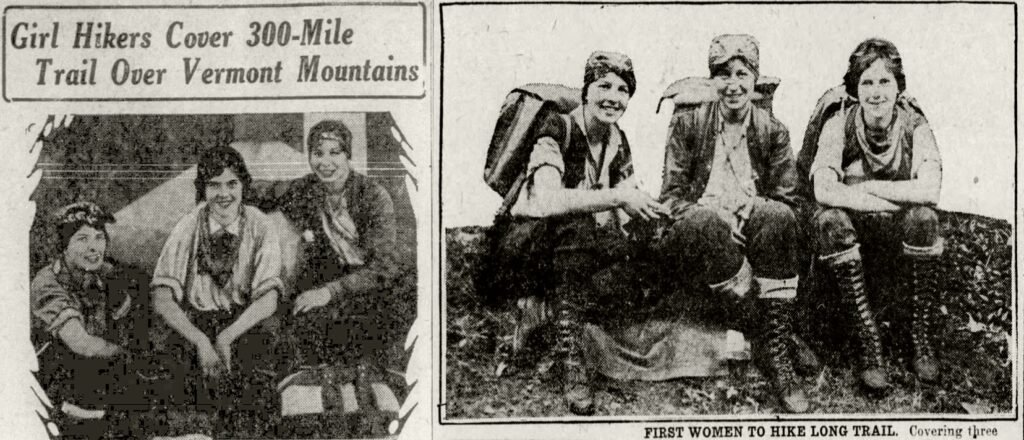
In an interview with the Burlington Free Press after their hike, Kathleen Norris stated, “We were not trying to establish a record. Appleby established a record for speed over the Trail, but we traveled in comfort.” With tongue firmly planted in cheek, the LTN stated that the Trail “had been improved since Mr. Appleby went over it,” just weeks before.
Appleby believed the GMC should have been more grateful for all the publicity that his feats generated and penned a long, vitriolic letter to the LTN, airing his grievances. He questioned why the Three Musketeers didn’t receive the scrutiny he had: “You didn’t question or criticize the girls for one good reason, because they were girls, young, pretty, popular, and unusual.”
Determined to reclaim attention from the Three Musketeers, Appleby announced plans for a motion picture documentary about his next FKT hike in 1928, proclaiming it would generate enormous publicity for Vermont, the Long Trail, and himself.
The Springfield Daily Republican described the project in words likely penned by Appleby himself: “…with Mr. Appleby, in the stellar role, attempting to jog from Canada to the Bay State line more speedily than mortal has ever trudged…”
Frustrated at having been slowed down by hiking companions on his previous mountain marathons, Appleby announced he would be traveling solo on the next attempt: “I have now adopted for my motto, ‘He travels fastest who travels alone’.”
The debate finally began to subside when Appleby pivoted from setting speed records to using his marathon skills to deliver medical supplies to flood-ravaged communities in the Winooski and Lamoille Valleys after the Great Flood of November 1927. He also softened his stance on the Three Musketeers, later penning a poem, “Modern Girls,” in their honor. The 1928 hike and documentary never materialized.
Documentation Matters
One important lesson from the Appleby controversy was the importance of documentation. In 1927, the LTN stated: “While nobody who is on the Trail for enjoyment wants to go over it at express train speed, the fastest time in which it can be traversed is an interesting question of endurance and speed, and the record of it should be accurately kept and not open to question. We understand that Mr. Appleby was asked to give the itinerary of his 1926 hike, and failed to do so, and that some doubt has been raised as to his time as a consequence.”
If Appleby had provided consistent, accurate documentation, the debate likely would have been more civil, and his accomplishments wouldn’t have been tarnished.
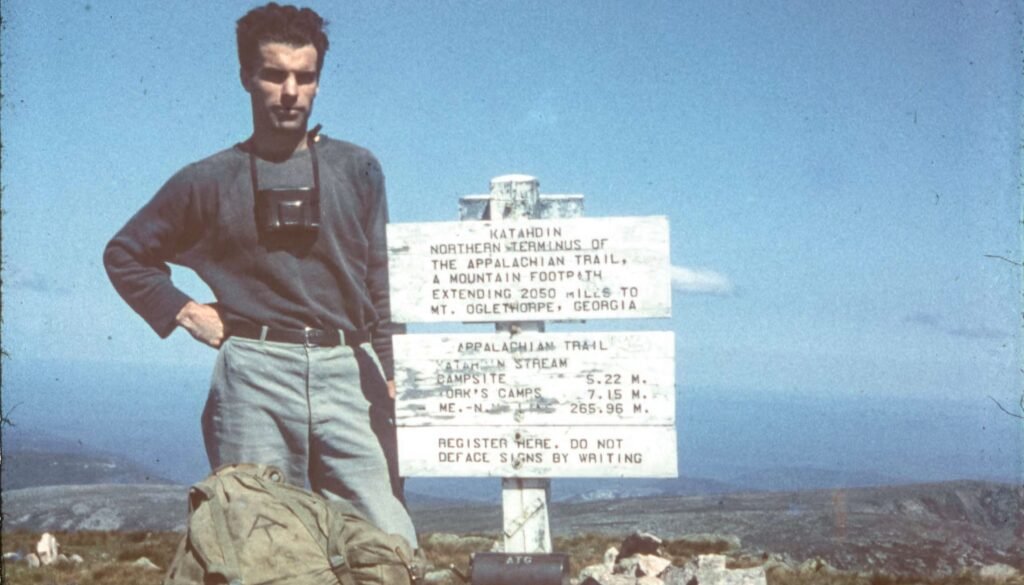
Decades later, when Earl Shaffer hiked the AT from Georgia to Maine in 1948, he provided documentation of his journey in the form of photographs, a daily journal, and a written summary to the Appalachian Trail Conference (ATC). After some scrutiny, he was recognized as the first thru-hiker to complete the Appalachian Trail and, by default, held the FKT.
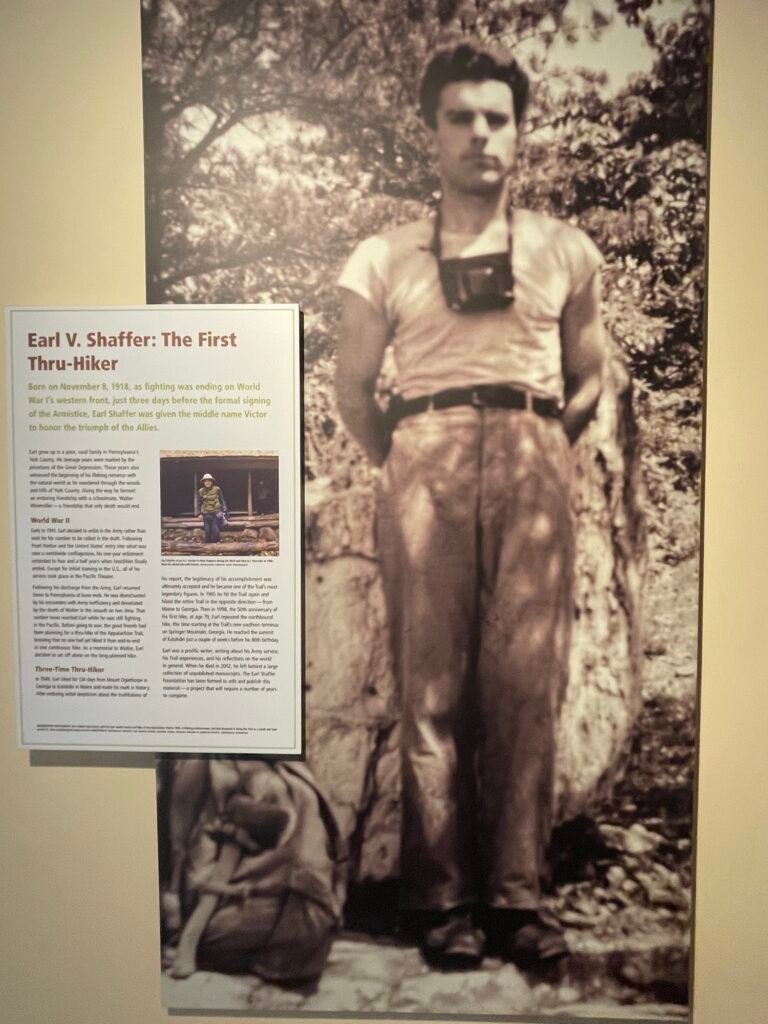
But some in the hiking community still question whether Shaffer missed portions of the trail. Many years later, a story surfaced about a group of Boy Scouts, including Max Gordon, who may have preceded Shaffer on their own thru-hike in 1936. The story seems authentic, but there is no documentation to support that assertion.
Today’s FKT records rely on GPS tracking devices, which can be viewed in real time and show the device’s location, providing proof that the course was accurately followed. Witnesses, including spectators, pacers, and support crew, add credibility to many FKT attempts. Although documentation is no longer in question, the debate over the merits of racing rages on, a full century after Appleby’s FKTs.
In 1931, James Gordon Hindes wrote in So Clear, So Cool, So Grand: “Those who rush along, attempting to set records… lose the very heart of the trail. How nature can mean a great deal to them is beyond my powers of reason.” Those words, likely referring to Appleby, would be at home in today’s online debates.
Off to the Races
I peeked through the hood of my sleeping bag as the first rays of sunshine began to flicker through the trees, illuminating the lingering mist. After days of rain, it looked like the wet weather would finally break for the last push to the Canadian border.
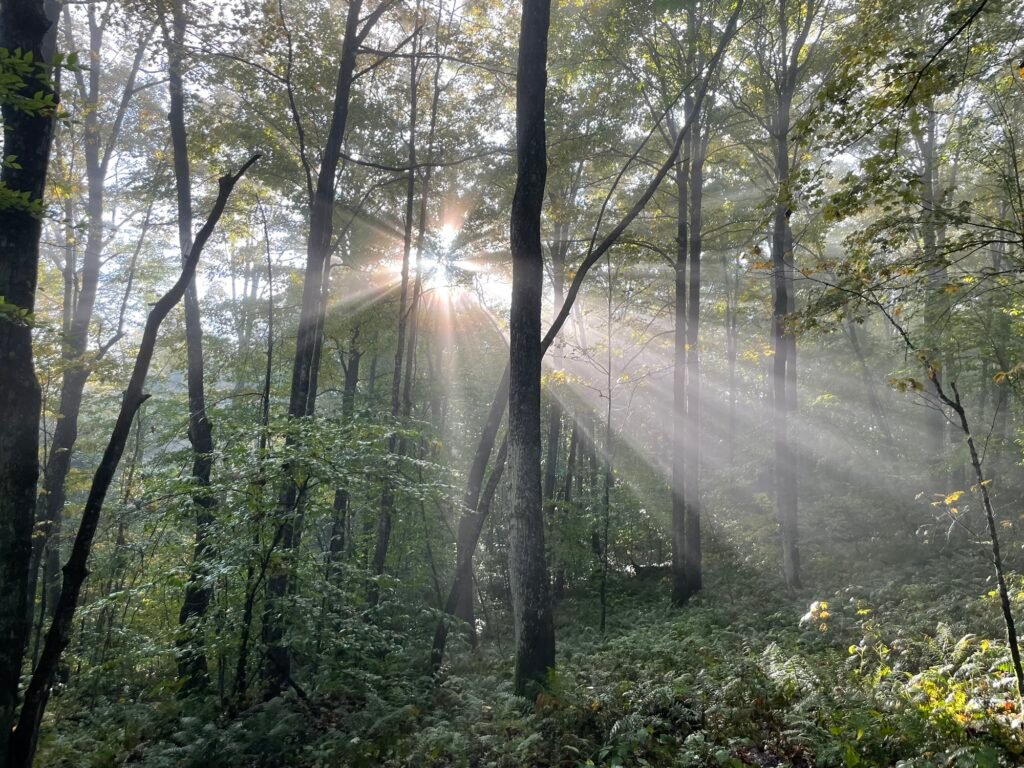
As I sat up, shaking off the cobwebs of too much sleep, the shelter seemed less crowded. Someone must have stepped out to heed nature’s call. Then I noticed that the edge of the platform was empty, and the hiker who squeezed in at our feet last night had already gone before daybreak.
I was impressed, and perhaps just a little jealous of what he was attempting. I had to remind myself that it’s not a competition and that my own journey was no less impressive. But that’s another story.
With just over 48 miles to go, he’d likely be at Journey’s End in two days. I planned to cover the same distance in four and a half days, deliberately slowing down to savor the final miles of the Long Trail—a saunter as Muir would call it. I wasn’t ready for my journey to end just yet.
I smiled at the thought of the fast hiker finishing well ahead of me, knowing there was room for both hiking styles on the trail.
Tim “Porkie” Bennett
Postscript
I first stumbled on the Appleby brouhaha while researching historical details for my forthcoming memoir, One Mountain After Another, which compares my father’s 1937 hike on the Long Trail with my own journey. There wasn’t room in the book to fully explore the controversy, so I set the research aside, thinking it could be a fun article or blog post timed with the 100th anniversary of Appleby’s first FKT.
As I wrapped up this piece, updates about another FKT attempt started appearing in my social media feed. Celebrated ultra runner Kristian “Captain” Morgan had just started a northbound self-supported AT hike. I believe this was his seventh or eighth FKT attempt.
I decided to pay closer attention to the updates this time, thinking it would be cool if he set a new record on the unofficial 100th anniversary of FKTs. On day 9, his GPS tracker went offline, sparking online speculation on his whereabouts. A few days later, he posted an update saying he decided to discontinue his record attempt and was at peace with that decision:
“For the first time in a long while, I’m not walking for a record.
I’m simply walking the Appalachian Trail because that’s exactly where I want to be.”
It’s hard to argue with that. Congratulations Captain!
PPS:
A little more than two weeks after first publishing this blog, another high-profile endurance athlete returned to the AT for another crack at the FKT, after coming up short in 2025. On August 11, 2026, John Kelly departed Katahdin with a positive attitude and different mindset:
“I want to maintain greater joy and appreciation throughout this… Honestly, my biggest regret from last year’s attempt is not fully enjoying it, even more than not finishing… being out on that trail is an unbelievable privilege that should be celebrated.”
On day eleven, he discontinued his FKT attempt in Vermont after 500 miles. He felt good physically and was on record pace, yet pulled the plug. His explanation echoed a concept many thru-hikers are familiar with: “Never end your hike on a bad day.” Finishing on a good day helps you stay objective about your reasons and leave with few regrets. His words reflect that idea:
“I found something far more valuable & rare than any record. Contentment. Fulfillment. Nirvana.”
It’s an interesting coincidence that these highly competitive athletes abandoned their attempts after discovering priorities that ultimately mattered more to them than speed records. The cool thing is that you don’t need to attempt an FKT to find those same rewards. Many of us experience similar feelings of contentment, serenity, and a sense of place while simply hiking the trail.
Leave a Reply